Email : sales@xhanco.com
Phone : +8619129236778
A certificate for a resin or component is not automatically a certificate for the finished cup, utensil or wrapped kit. Buyers of compostable foodservice packaging should verify what the issuer actually assessed, which item is covered and which composting environment the claim describes before approving artwork or a tender response.
This evidence-focused procurement briefing was reviewed on 16 October 2026. It explains how to read certification scope using primary information from BPI, with environmental background from the European Commission. It does not declare that any XHANCO product holds BPI certification, and it does not replace a certification body's decision about a particular construction.
BPI's certification FAQ states that certified resins, films and intermediates cannot simply be sublicensed as finished products: the finished product must go through certification. Its application guidance also ties disintegration approval to the tested item's maximum thickness or grammage. A genuine upstream document may therefore still cover the wrong object or construction for the proposed claim.
The European Commission's materials policy overview distinguishes compostable plastics that need controlled conditions from biodegradation in other environments. Do not turn an industrial claim into a home-composting instruction or an assurance about breakdown in soil, water or landfill. Bio-based origin alone does not establish compostability.
For a practical review, write down the proposed claim first. “This supplier uses a certified resin” and “this printed finished cup is certified” are different statements. The document must support the one that will appear on the product, quotation or marketing page; a familiar logo does not close that gap.
PLA-coated paper cups. The XHANCO XH-FD-001 cup combines paper and a PLA coating. In a review of a construction like this, identify the finished cup, coating, print and other relevant constituents. Ask whether the supporting certification covers the ordered structure and any permitted variants. Do not infer complete-cup coverage from a document describing coating pellets alone.
A change in paper structure, coating quantity or print configuration should trigger a documented scope check. The appropriate question is not whether every change always needs a new test, but whether the certifier's existing approval includes that variation. Obtain a written answer where the boundary is unclear.
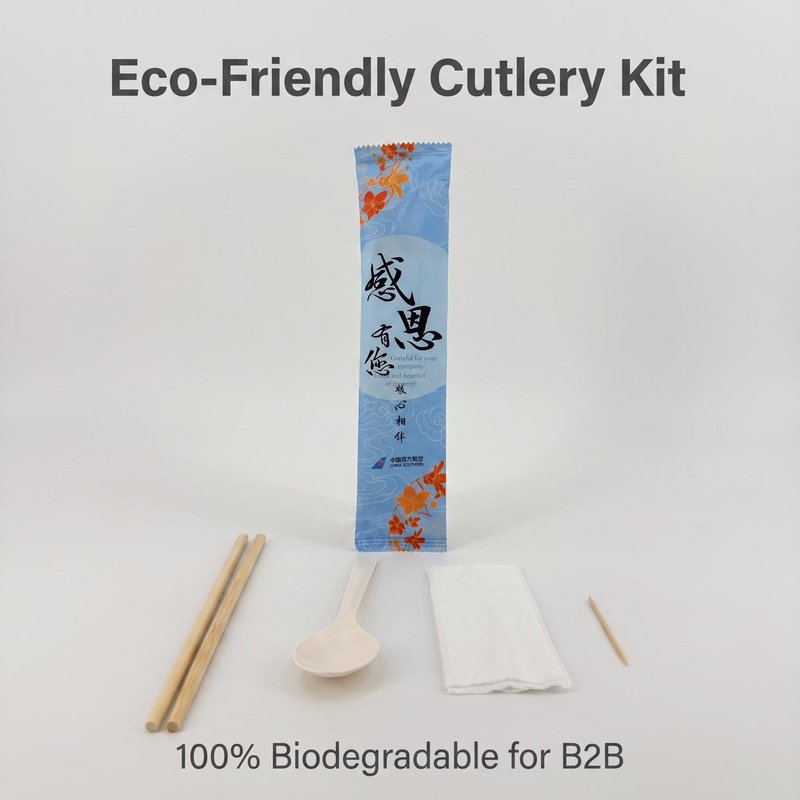
Mixed-material cutlery kits. The four-piece kit XH-CK-4PC-200-001 lists bamboo or wood chopsticks, a PLA spoon, a paper napkin and a wooden toothpick. Its outer wrap is another item to identify. A spoon-related document should not be stretched to cover the wrapper, and a wrapper-related document should not be stretched to cover the assembled set.
Keep the component schedule and the environmental claim at the same level of detail. If evidence concerns only one component, restrict the statement to that component rather than describing the whole kit as certified. Product links here identify examples to assess, not evidence of certification status.
BPI's certified-product catalogue guidance explains that its public records identify approved products and licensed sellers down to item number. It also distinguishes commercial compostability from items separately identified as home compostable. Match the actual supplier and item rather than stopping at a similar company or product-family name.
BPI's certification and sublicensing guidance makes a separate point for private-label sales: selling certified finished products under another brand can require an agreement involving the licensee, brand owner and BPI. Permission to use the mark is not established simply by receiving the supplier's certificate scan.
These are scheme-specific examples, not a statement that every certifier uses identical procedures. Ask the actual issuer about transfer, private-label or logo-use conditions. Do not alter the holder name, validity, item description or logo on a certificate to make it resemble the ordered product.
These are current evidence and scheme-review steps, not a new regulation announced today. A planned certificate application, forthcoming test report or expected renewal is not a current completed approval. If evidence is pending, mark the claim pending and do not print the certification logo in anticipation of a favourable result.
The useful buying decision is a documented match between the ordered item, the supported statement and the intended waste route. Broad phrases such as “fully degradable everywhere” obscure those conditions and are less informative than a precise, verifiable description.
Contact XHANCO with the product number, destination, finished construction and evidence required for a specification review. Available documents and their scope must be confirmed for the particular order; no certification should be inferred from this article or from material names alone.
Cover photo: Antonio Araujo / Unsplash, under the Unsplash License. Illustrative wooden utensil arrangement; not a XHANCO product, PLA sample, certificate or laboratory-test result.
Email :sales@xhanco.com
Email :Sales@xhanaero.com
Tel :+8619129236778
Whatsapp : +8619129236778
4/F, Building E, No. 5 Xinhe South Road, Zengcheng District, Guangzhou, China


Leave A Message
Scan To Wechat :

Scan To WhatsApp :


 Product categories